How to Reuse N95, KN95, and Other Disposable Masks


I Never Knew My Daughter Had A Food Allergy. Then A Stranger Saved Her Life
We moved our family from upstate New York to West Palm Beach, Florida, in 2021, and excitedly descended upon sunshine and warmth with only our summer clothes and little family of four in tow. Without any family or friends nearby, we enrolled our two young children in a school near our downtown condo and almost immediately got to work familiarizing ourselves with the school and community.
I made a mental note of an image of a red shoe that popped up regularly: taped on classroom doors, on a pamphlet in the main lobby and spread throughout some other school materials. "What's the red shoe all about?" I asked the Head of School. She told me to look up a nonprofit called Red Sneakers for Oakley and read the story on their site, but gave me the truncated version in passing, which was hard to do given the devastating nature of it. The shoes represented a favorite pair once worn by Oakley, a young boy who lost his life to an allergic reaction to nuts. He'd attended this very school at the time of his passing. Thereafter, his parents founded an organization to advocate worldwide for food allergy awareness and the use of epinephrine, something that was not used at the time of his passing, and that his parents openly wish had been.
I stayed up late that night reading everything I could about Oakley and his selfless, unbelievable parents. My throat was lumpy and I cried quietly looking at the photos they shared of their beautiful boy. Their Instagram account was a wealth of knowledge: top allergens, how and when to use epinephrine injectors (often referred to by one well-known brand name, EpiPen), signs of a reaction and more. This page was like a magnet for my brain — I wanted to know everything I could about how to prevent the tragedy they endured and was in disbelief of how little I knew about food allergies.
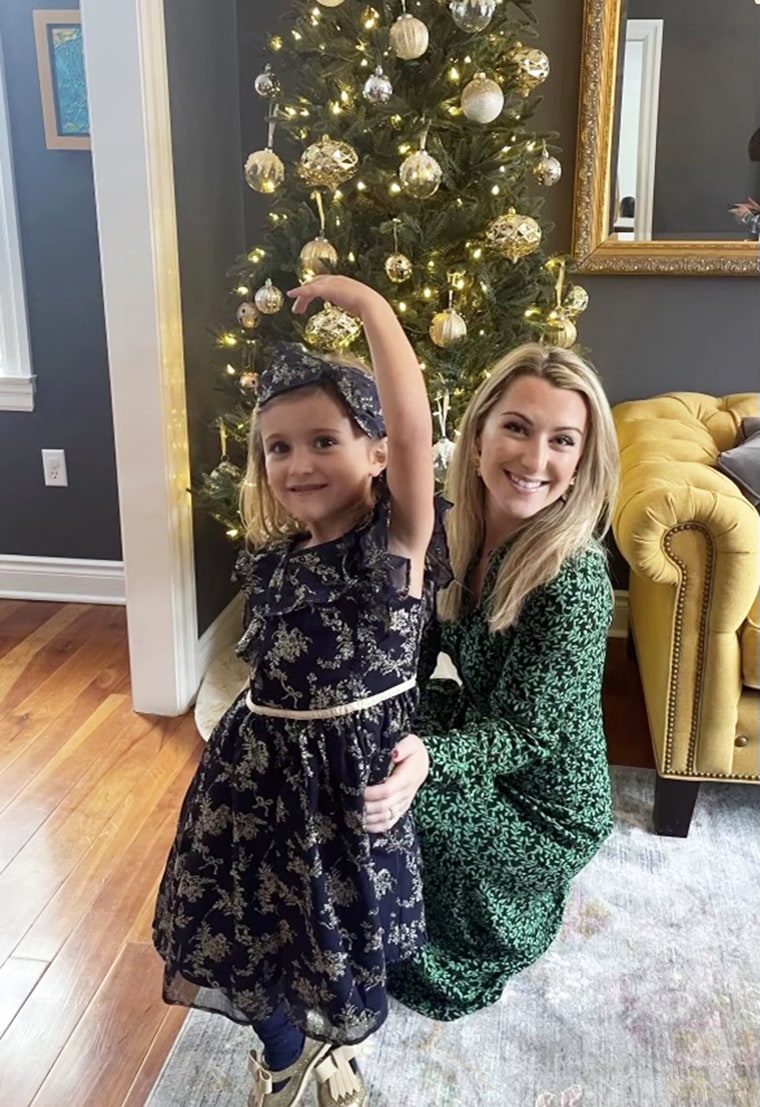 My daughter and me.Courtesy Meg George
 A few weeks later, my husband and I walked our kids a couple of blocks away for a holiday kickoff celebration in downtown West Palm. It was dark and late, so our kids, 3 and 5 at the time, were strapped into their double stroller. They begged us for ice cream and we agreed, joining other families in a long line behind a cute pink food truck selling "superfood ice cream." I read the choices out loud, not mentioning to my toddlers that the ice cream was made of nuts so they didn't judge it before they tried it, and finally ordered two cups of vanilla with sprinkles.
They took their ice cream while we pushed them to a better location near the tree lighting activities, snaking our way through thousands of other people there for the events. My daughter picked a sprinkle out of her bowl and immediately asked me to itch her finger. I complied. About 30 seconds later, after she'd scarfed down a few spoonfuls, I looked at her face and my heart stopped. "Is something wrong?" she asked me from behind her big brown eyes. And unfortunately, something most certainly was. Her face was distorted, swollen around her cheeks and producing red and white welts around her lips that she was ferociously itching.
I screamed, picked her up and yelled incoherently to my husband that we needed help. Oakley's images flashed through my mind at lightning speed — because of his parents, I knew we needed epinephrine. Without having taken my husband through the food allergy education journey that I went on during my recent Instagram rabbit hole, he felt clueless as to what could be wrong. I know other parents who have been in moments of panic can relate to the reflection as a haze — I hardly remember the confluence of events or exactly how they transpired because of the blackout that can accompany tragedy.
My husband followed my cues, running alongside me and pushing our terrified son in the stroller while I held our daughter and screamed for help. To be honest, I don't know what I screamed, but I know that it was enough to attract the person who saved our child. A man approached us with his wife and young son trailing behind. "Do you need an EpiPen?" he asked us, and then added, "I'm a doctor and my wife has one in her purse. Do you want me to administer it?" It was like I was having an out-of-body experience. I shouted an enthusiastic yes while my husband called 911. Some of this felt like hours and some of it felt like milliseconds, but her symptoms started to improve within a minute of the injection, and I was flooded with relief when the doctor told the paramedic upon the ambulance's arrival that she was going to be OK.
I'll never forget getting in the ambulance with my little girl, the whites of her eyes bright red and hives popping up along her blonde, curly hairline. The doors closed as I waved to my deflated husband and sobbing son. Who can he call to help us? I thought to myself. Dang, moving across the country had quickly lost its luster. We needed our village. I was scared, and we were alone. The firefighters in the ambulance were compassionate and knowledgeable. As a favor to her mom, I'd like to think, my daughter delivered some comic relief once she got her bearings. She looked a young, hunky fireman straight in the eyes and said her first sentence since the allergic reaction had happened: "I really like the way you look." Exhale. She was definitely going to be OK.
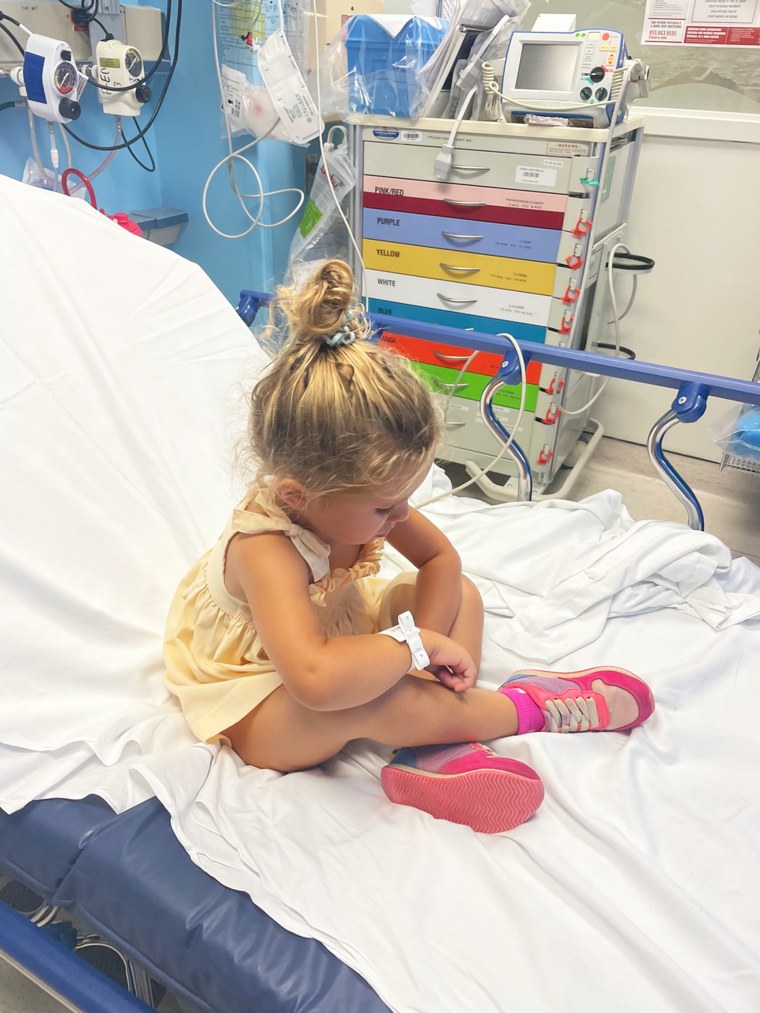 My little girl in the hospital after her allergic reaction.Courtesy Meg George
 We spent the majority of that night at the hospital, my husband joining us once he secured a babysitter from a nearby college to come be with our son. After our daughter was given Benadryl and steroids, and had spent hours under observation, we were sent on our way — to start the rest of our lives forever changed.
My husband drove to another town at 3:00 in the morning to the only pharmacy open to get our EpiPen prescription filled. I only knew to ask the emergency room physician for this because of Oakley's parents. I wrote to them from the hospital parking lot, expressing gratitude, which didn't feel like nearly enough. Epinephrine had saved our daughter's life.
In the weeks following, bloodwork and skin tests at the allergist confirmed her food allergies, particularly to cashews, the main ingredient in the infamous ice cream treat, and forevermore, epinephrine injectors are an extension of our body. Life was challenging in the wake of this event. I went to therapy for a long time, and my already obsessive and anxious tendencies saw some of their worst days. Checking on our daughter, hammering home to teachers, caregivers and our visiting family members what she could eat and what she couldn't felt like a new, stressful job that I never wanted.
Our daughter is a responsible advocate for herself, despite her young age, and still, she's strapped with the worry of whether anything from a grape to a potato chip is safe. Oakley's parents, who have experienced the worst, have devoted their lives to helping others. A doctor enjoying a holiday event with his family saw us in need and rescued us. No matter how painful the memory, it's our turn. Familiarize yourself with food allergies even if your kids don't have them — we did, and I am grateful for it every single day. As with most things, time does heal wounds, and knowledge is more powerful than fear.
Mother Sues Chick-fil-A On Behalf Of Son, Alleging Nuggets Sent Him To Hospital
A mother has filed a lawsuit against Chick-fil-A on behalf of her teenage son, alleging that an order of chicken nuggets sent him to the hospital with a severe allergic reaction.
On Aug. 16, a complaint was filed with the Supreme Court of the State of New York in the county Of Erie over eight causes of action, including negligence, infliction of emotional distress and unfair and deceptive business practices, as first reported by Insider. The plaintiffs, J.P. And his mother, Francine Powers, allege that a misrepresented order of chicken nuggets ordered from a Chick-fil-A restaurant in Erie sent the boy, who has a "life-threatening dairy allergy," into anaphylaxis.
Chick-fil-A declined to comment for this story.
"J.P's mother, Ms. Powers, trusted Defendants products were safe for her son," the lawsuit reads, adding that before ordering food from the Chick-fil-A, Powers checked the nutrition and allergen disclosures on its website to confirm that the Grilled Chicken Nuggets didn't contain dairy, and it said they didn't.
The plaintiffs say that on Aug. 13, 2022, they visited the Chick-fil-A located on Transit Road in Depew, New York, which is owned and operated by co-defendants the Privitera family. The store operators did not respond to a request for comment from TODAY.Com.
"Prior to placing an order, Ms. Powers disclosed J.P.'s life-threatening dairy allergy to the Chick-fil-A employee, who responded that the Grilled Nuggets did not contain dairy," the lawsuit reads, adding that because of the employee's response, she ordered the nuggets as well as an order of waffle fries for her son.
The suit states that soon after eating the order of nuggets from the Chick-fil-A restaurant, J.P. Started to feel ill, so Powers contacted the store in question and "was again told there was no dairy in either the Grilled Nuggets or Chick-fil-A Waffle Potato Fries" that he had consumed. Powers says she was also told that there had been no recent changes to the ingredients in either of those items.
"J.P. Then began foaming at the mouth, excreting excessive saliva and mucus from his mouth and nose, and felt his throat start to close," the lawsuit continues. Plaintiffs state that the teen was then rushed to a nearby pediatric emergency facility, and by the time he arrived, he had a swollen face and was in pain from experiencing what they say was a "dangerous allergic reaction."
Powers says, 10 days later, she spoke with the Chick-fil-A location two times about the possibility of dairy being in the items that J.P. Consumed, claiming both times she was told that neither item contained dairy.
Then, Powers claims, on Aug. 29, 2022, she saw a post in a food allergy support group alerting members that the Grilled Nuggets served at Chick-fil-A restaurants "did in fact contain dairy."
The suit claims that more than 10 days after J.P's anaphylactic reaction and hospital visit, Chick-fil-A changed its nutrition and allergen disclosure on its website to show that the product contains dairy.
Powers is seeking a trial by jury and substantial damages.
In August 2022, Chick-fil-A announced in a statement that its Grilled Nuggets and Grilled Filets contained an undeclared dairy allergen due to a "supplier mishap," adding that it was actively working with its supplier to ensure the allergen would be removed. The chain also said that the issue wouldn't happen again, saying at the time, "Our priority is that our impacted guests can enjoy these products again soon."
As for whether or not dairy is still listed as one of the allergens for those menu items, the Chick-fil-A website now reads, "We are happy to inform you that the dairy ingredient has been fully removed from both the Grilled Filets and the Grilled Nuggets."
This story first appeared on TODAY.Com. More from TODAY:
Under-Eye Swelling: Causes, Symptoms And Treatments
A variety of factors can cause under-eye swelling, including medical conditions, anatomy and diet-related swelling.
Medical ConditionsDermatitis, dermatomyositis, renal disease and Graves' disease are all examples of conditions that affect body tissues and result in under-eye swelling, according to Bartholomew. For example, renal disease, which affects the kidneys, can lead to swelling around the eyes due to the kidneys leaking large levels of protein into the urine, which results in eyelid edema (swelling).
Graves' disease, an autoimmune disorder present in 1 in every 100 Americans that can lead to hyperthyroidism (an overactive thyroid), causes eye problems for around 33% of those living with it . Graves' ophthalmopathy is when your immune system attacks the tissues and structures around the eyes, causing swelling and puffiness.
Allergies can also cause your eyes to swell as the protective covering of your eyelid, known as the conjunctiva, becomes swollen from an external irritant.
Infections"Infections such as periorbital cellulitis [a soft tissue and skin infection around the eye], blepharitis [inflamed eyelids] and conjunctivitis [eye infection caused by bacteria or a virus] are common reasons for under-eye swelling, as well as styes and chalazion (inflammation of the eyelid glands) " says Anthony Rossi, M.D., board-certified dermatologist and dermatologic surgeon with Memorial Sloan Kettering Cancer Center in New York and the founder of Dr. Rossi DERM MD skincare.
Fatty BagsFatty bags, known as orbital fat pads, are cushions that surround and support the eyeball in the socket, explains Maya K. Thosani, M.D., dermatologist, micrographic dermatologic surgeon and owner of Modern Dermatology in Scottsdale, AZ. "When these grow or protrude, it can cause swelling and bags around the lower eyes".
Vascular CirclesDilated veins around the eyes, which cause vascular circles, may be the root of under-eye swelling. "When these veins dilate, it causes blue-tinged swelling and darker circles, which become more prominent as we age or lose volume in the face," says Dr. Thosani.
Structural ShadowsUnder-eye swelling may also be a feature of your facial anatomy. "While prominent shadowing can cause swollen eyes, there are also some conditions like exophthalmos (where your eyes move forward and appear to pop out) that create a look of swelling," says Dr. Thosani.
Under-Eye HollowsAging can cause volume loss in the upper portion of the face, says Dr. Thosani. "The tear trough [under-eye] hollows, resulting in the lower eye area looking fuller and swollen."
DietFactors like smoking, diets high in sodium, diets high in fat and excessive alcohol can cause eyelid edema, a swelling that results from vascular [the body's blood vessel network] congestion, explains Dr. Thosani.


Comments
Post a Comment